People seeing HAPPY TEARS for the first time almost always ask the same question:
"Does this bath soak actually have chili in it?"
It wasn't added to look unusual. The real reason is pretty simple — I couldn't find a bath soak on the market that was actually specialized for a half-bath, which is what I wanted.
Half-bath for 30 minutes — so why no sweat?
I used to have days myself where a half-bath just didn't produce sweat. I'd run the water, sit down, and thirty minutes would pass. I'd check the mirror and there wouldn't even be moisture on my forehead some days.
I actually got a customer inquiry today about this exact thing — not sweating during a half-bath. When that happens, I try to walk through the possibilities with the customer and find a solution together. This blog barely gets any traffic, but today I wanted to write this down partly to organize my own thinking, and partly in case it helps someone else — ten reasons a half-bath might not be making you sweat, and along the way, why I ended up putting chili in the soak in the first place.
The basic principle of sweating during a half-bath
The principle itself is simple. Soaking your lower body in warm water gradually warms your whole body, and your body sweats to regulate that rising temperature. But even at the same water temperature (say, 40°C) for the same amount of time (say, 20 minutes), one person sweats freely and another barely sweats at all. The reason lives in the bathroom environment and in individual differences.
10 reasons a half-bath might not make you sweat
- The water is cooler than you think. Even the same 40°C feels different to different people.
- The half-bath is too short. The body typically takes 10–15 minutes to actually warm up.
- The bathroom air is too cold. Heat keeps escaping through your bare shoulders and arms.
- Sweat is evaporating instantly. In a dry bathroom, a small amount of sweat evaporates immediately, so it can feel like nothing's happening.
- The water level is too low. Less of your body submerged means less heat is transferred.
- Your body was already cold before you started. If you're cold going in, the heat goes toward warming you up first, before it can push you into sweating.
- You're not used to a hot environment. If this is your first half-bath, sweat can come later than you'd expect.
- You naturally sweat less than other people. That's just individual variation.
- You're dehydrated. Drinking enough water before and after a half-bath genuinely helps.
- Medication or a health condition is affecting it. In that case, it's better not to push the water temperature too high.
If it's your first half-bath, ease into it this way
If you're not someone regularly exposed to a sweat-inducing environment like a sauna or intense exercise, keep in mind that a half-bath might not produce sweat right away the first few times. Drink enough water beforehand, and rather than sitting in half-bath position and enduring hot water for a long stretch right from the start, try fully submerging up to your neck first to warm your whole body, then pulling your arms and upper body out of the water and easing into it slowly. I'd genuinely recommend that.
Adding heat to the core of a half-bath: the lower body
Back to today's real topic.
I didn't want to just make one more fragrant, water-soaking bath soak. I wanted a half-bath soak where the lower body definitely gets hot, and that heat extends up to the upper body.
A half-bath works by soaking the lower body in warm water, gradually warming the whole body. So what if we delivered that heat more clearly to the lower body — the actual core of a half-bath? What if, alongside the warm water, we stimulated the thermal receptors in the lower body directly, so the heat is felt more clearly, and the whole warming sensation of the bath got stronger?
That's the thinking that led me to chili.
I can't say definitively that a chili ingredient directly treats or regulates blood circulation or sweating. But when warm water and chili's distinctive burning sensation combine, the heat felt in the lower body becomes far more distinct, and the process of the body warming up and sweat forming can genuinely be felt faster than with a typical bath soak.
What I wanted to make wasn't simply a product where your skin feels spicy and stinging. I wanted heat that starts in the lower body and extends through the whole body — a soak that gives you the feeling of "I actually did a proper half-bath."
What chili changes is the bathing sensation
Chili doesn't raise the actual water temperature in the tub. But when warm water and chili's burning sensation are felt together, the heat in the lower body reads far more clearly.
In our own testing, compared to other bath soaks, the warming feeling in the lower body was stronger, and sweat forming on the upper body was noticeable sooner. If other bath soaks are a comfortable bath you enjoy for scent and color, HAPPY TEARS is closer to a half-bath where, as time passes, you find yourself thinking, "whoa, this is actually really hot?"
It's not simply a difference of chili being in the mix. The bathing experience I wanted to build, from the very start, was a different one.
A warmth that doesn't fade easily
One more difference I've felt using HAPPY TEARS: the water doesn't cool as quickly during a half-bath.
In a typical half-bath, the water goes lukewarm as time passes, and you sometimes need to top it up with more hot water. On the days I use HAPPY TEARS, the initial warmth and the burning heat sensation both last relatively long, right through to the end of the soak.
I can't say this is purely the chili ingredient's doing — it's more likely the whole formulation working together. But the difference actually felt in the tub is clear. Exactly how much more slowly the water cools would need a real temperature measurement under matched conditions to say precisely, but at least the felt sense that the heat doesn't fade easily is an important part of what HAPPY TEARS is.
This is the real reason chili is in it
This particular bathing sensation is the reason to choose HAPPY TEARS. Instead of making one more fragrant bath product, I wanted to make something for people who want to properly warm their lower body and sweat during a half-bath at home, especially after exercise. That's the real reason chili is in HAPPY TEARS.
The differences between bath soaks aren't only about scent and color — they're also about what sensation gets delivered to your body during the twenty minutes you're sitting in the tub.
Today's review of the reasoning, done.
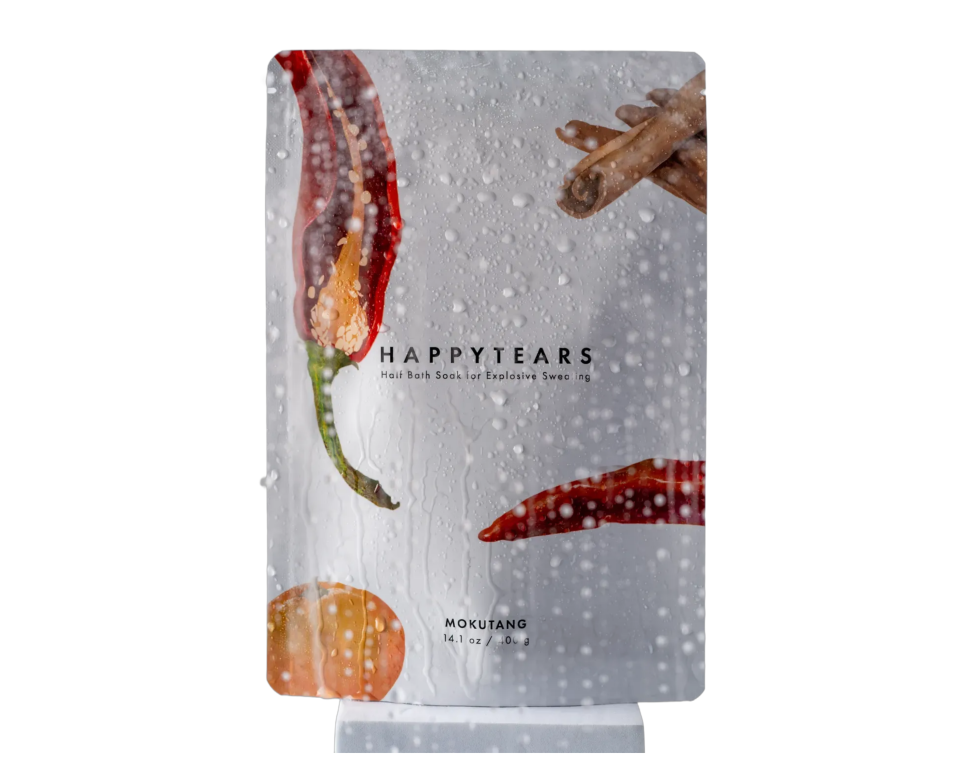
Happy Tears Bath Soak
$22.90 · 7.05 oz jar · 4.0★ (60)