Today, buying a Japanese onsen bath soak I'd been curious about, I remembered a phone call I had with a customer a while back.
She'd repurchased HAPPY TEARS, and while we were chatting about the product, she said something like:
"I really wish I could buy a bath soak that recreates a real onsen, exactly."
I agreed with her, hard. Every time I come back from an onsen trip, I think about how much I'd love to bring that onsen water straight home into my own tub. How happy would it be if real onsen water just poured out of my bathroom faucet every day. Just picturing it feels good.
But even mid-conversation, I couldn't quite bring myself to say, "I can make a bath soak like that." I wish I could have. Instead, as someone who actually makes bath soaks, a colder thought came to me: making a soak that truly recreates a real onsen is close to impossible.
Does containing an onsen's ingredients make it an onsen?
Onsen water carries sodium, calcium, magnesium, sulfate ions, bicarbonate ions — a different composition at every single spring. If you look at the mineral analysis chart posted at any onsen, each component's content is written out quite precisely.
So if we mixed those exact ingredients into water at the same ratio, could we recreate that onsen? In theory, maybe — you could probably make water of a roughly similar composition. Add a sulfur-type scent, get the water color close, combine the inorganic salts the onsen contains — at least to the eye and nose, you could make a plausible onsen soak.
But having the same numbers on a chart doesn't make it the same onsen. Onsen water meets rock underground for a long time, carrying its components up to the surface under heat and pressure. Even after it reaches the surface, it keeps changing on contact with the air — gas escapes, some components oxidize, some precipitate out of the water. Water that was clear at the source sometimes turns cloudy or brown by the time it's in the tub.
So no matter how many components you mix by matching numbers on an analysis chart, you can't recreate the time and change that real onsen water has actually been through. You can make the look and the smell similar. The water itself can never become the same water.
Was what we loved at the onsen really just the water?
More than anything, what we remember loving about an onsen was never just the water.
An open-air bath, entered while bracing against cold winter air. The stones and trees around the tub. Air thick with humidity. Mountains and forest through a window. The sound of water flowing in from somewhere, continuously. That excited feeling of having actually traveled somewhere. A cold bottle of milk after the bath.
All of it combines into a single onsen experience. That's exactly why even bringing the identical onsen water home to your own tub couldn't be completely the same as what you felt on location. Our home tub is a different size. The air's temperature and smell are different. There's no scenery through the window at all.
Most of all — the me who traveled to that place, and the me stepping into my own tub after finishing an ordinary day, are already in different states.
An onsen isn't completed by water composition alone. The place and the time, the temperature and the air, the whole process of getting there, is part of the experience. Which means maybe a small packet of bath soak completely standing in for all of that was impossible from the start.
At this point it might start to sound like I'm just rationalizing why I can't make an onsen-recreation soak. But that doesn't mean a bath soak can do nothing at all.
Would a concentrated onsen soak be possible?
In Japan, there are bathing products made by actually concentrating real onsen water, or by collecting yunohana — the mineral deposits that form naturally at a hot spring's source. I buy products like this myself, out of curiosity, whenever I come across one.
Compared to a product that just expresses an onsen's general image, one that says it used real yunohana and real onsen water from an actual source feels somehow closer to the real thing. Some genuinely give you a scent, a sediment, a unique water texture that's hard to find in a typical bath soak.
Even so, I can't say that's completely identical to the local onsen. Water flowing directly at the source, and a product that's been through collection, purification, concentration, and storage, might share a starting point, but they're already different states of the same thing by the time they meet you. And the water you actually dissolve it in isn't onsen water — it's your household's tap water. Even mixing the concentrate into 200 liters of tub water, that moment doesn't recreate the local onsen water.
Maybe even a concentrated onsen soak isn't moving the onsen itself — it's closer to bringing home some of the components and traces that made up that onsen.
So what can a bath soak actually do?
Thinking this far gets a little deflating. If a bath soak can't replace an onsen, what should someone who makes bath soaks actually be making?
But asking that question is exactly what makes a bath soak's real role clearer. A bath soak doesn't need to perfectly replicate an onsen. It actually can't. Instead, it can pick out one of the many senses that felt good at the onsen, and let you experience that one thing more clearly, in your own tub at home.
Some product can carry a scent that recalls sulfur. Some can create the visual mood of a milky-white onsen. Some can give the unique texture of mineral-rich water. And some can simply let you focus on the moment itself — hot water on your body, sweat, all the strength leaving you at once.
Thinking about it, what I tried to recreate making HAPPY TEARS was never a specific onsen's ingredients, or its color, either. Among the many moments I loved at real onsens, and during ordinary half-baths at home, it was this one: body sinking into hot water, definitely warming up, sweating, and stepping out of the tub feeling — refreshed.
HAPPY TEARS isn't a product that transplants an onsen as-is. It isn't a product recreating some famous onsen's actual water, either. It's closer to a product that pulled out the one sensation I loved most at an onsen, and lets you feel it far more clearly, in the tub you already have.
A bath soak cannot replace an onsen
In conclusion — a bath soak cannot replace an onsen. It can express an onsen's ingredients, scent, and color in a similar way. It can contain real onsen water or real yunohana. It can create a bath that evokes that onsen.
But the time that onsen water has passed through, the air and the scenery of that place, even the state of mind of the person who traveled there — none of that can be contained in a jar.
So no matter what bath soak I make from here on, I don't think I can easily say, "you can experience a real onsen at home." That would be a promise beyond what any product can actually deliver.
Instead, I think I can say this: you can't bring the onsen itself home. But maybe one sensation we loved there can be taken back out again, into your own tub.
Maybe what a bath soak should do isn't pretend to be an onsen — it's reinterpret, in its own way, the good moment we felt at one.
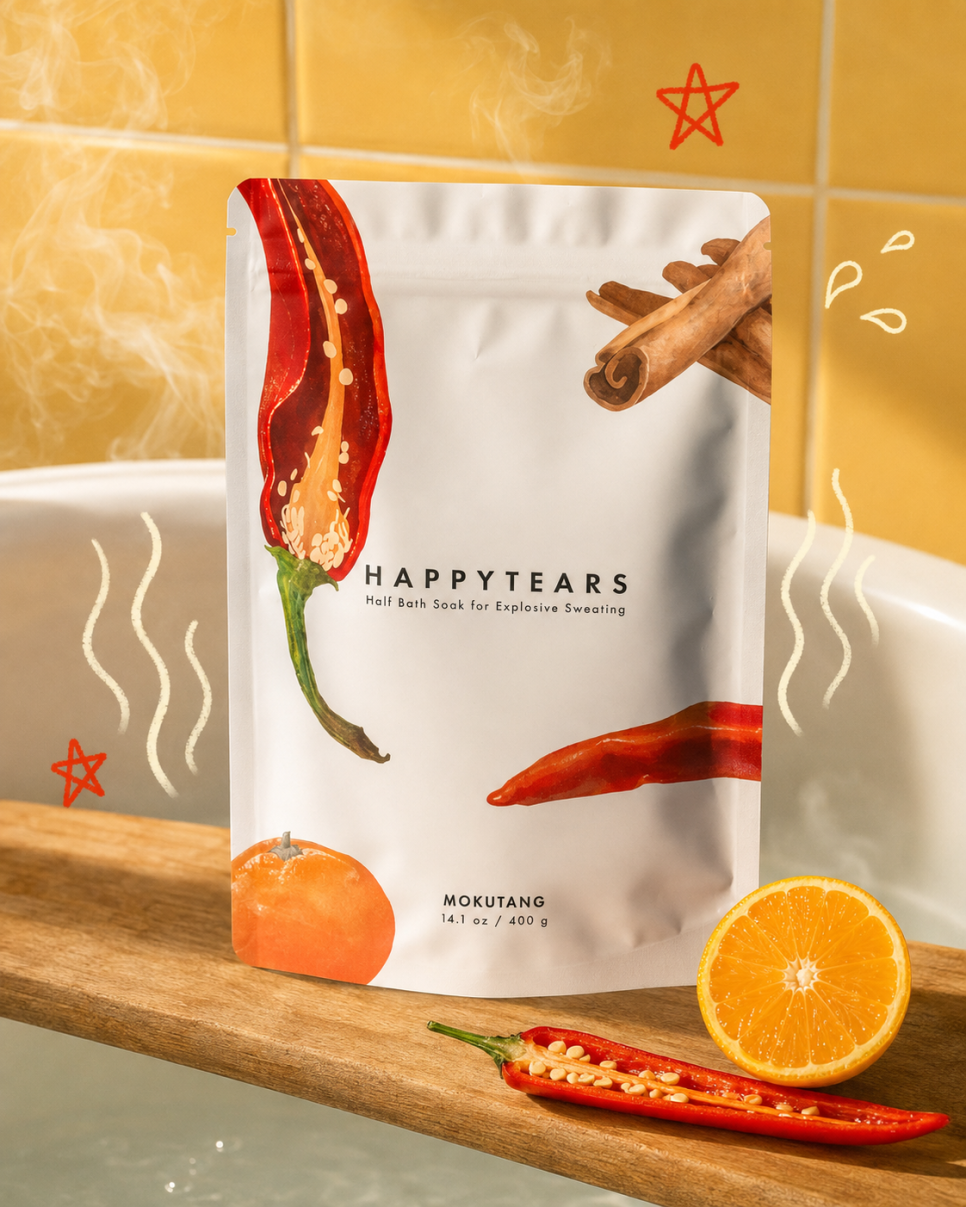
Happy Tears Bath Soak
$22.90 · 7.05 oz jar · 4.0★ (60)